
Two Miracles, Three
A homily for the Feast of St. Rita

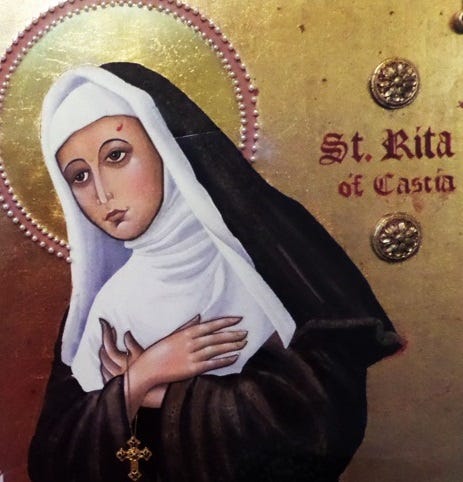
To know Saint Rita, that’s not the easiest thing to do.
Her biographies, you see, do not offer the real woman, or so it seems to me. That is, her story is covered over with so many biblical typologies and legends that it’s hard to discern the real figure of the real saint.
Before her birth, for instance, there was an annunciation; an angel appeared to her mother, Amata, foretelling the happy advent of her daughter. God also supposedly gave her parents her name, “Rita.” Later, married to Paolo, she was figured to be another Saint Monica.[1] That’s what I mean, the conventions of hagiography make it difficult to get a sense of Saint Rita herself, Saint Rita the woman.
Also, the extreme purity of her available biographies makes me wonder. Now, they’re not the miracle of the bees or the rose in winter or any of the other great miracles of Saint Rita’s life that I have trouble believing. It’s more things like the description of her childhood, that she was “so celestial that she appeared to be a little angel living in the world,” that she didn’t play with other children because she was too occupied by divine things.[2]
Look, I’ve got five kids, loveable each one of them; but I’m not buying that. I assume she was a normal kid, a normal little girl. You see what I mean? Her biographies are not the easiest things to read.
But that doesn’t mean I don’t feel close to Saint Rita, I do. But it is more a feel thing, a prayer thing. I’m talking about the mystery of the saints in Christ, what the Catechism calls “communion with the saints.”[3] Not everyone will believe this, but you see, the Church is bigger than us; it includes angels and the saints in heaven. And between the Church in heaven and the Church on earth there is a sharing of holy things.
Anyway, I don’t want to talk too much about that. Many people laugh at the Church’s most cherished treasures, and that’s fine. Holy things are for the holy. It’s just that I do feel close to Saint Rita no matter what I think about the biographies I’ve read. She’s our friend, our patron, our saint. And the thing is you can get close to her too.
But only if you draw closer to Jesus Christ. That’s the thing about saints; we get closer to them by growing closer to Christ. That’s of course true of ourselves; we can get close to one another by growing closer to Christ. And Saint Rita shows us how we can do this. Her life is an icon, a lesson in this.
It’s the lesson of two miracles, three really.
The first miracle is the miracle of the thorn. Saint Rita had gone to hear St. James of the Marches preach; he was one of the great Franciscan preachers of his day. Listening to him preach on the Passion of Christ, a subject that had enraptured her since she was a child, Saint Rita was so moved that went right back to the convent, to their chapel; and there before the crucifix she begged the Lord to feel at least a little of his suffering.
Then, so the story goes, a thorn from the crown upon the crucifix, with sudden force, lodged itself in her forehead. A strange kind of stigmata, it was a mystical gift. She wanted to share in the Passion of Christ, which is what Christ wants all his disciples to want, and that’s what he gave her in a unique way, what one biographer called “exquisite pain.”[4]
Now I don’t know if I’d pray that myself, but I get the point, a deeply Christian point. It’s about taking up the cross, uniting oneself with the Crucified, about “always carrying in the body the death of Jesus,” as Paul said.[5] It’s about loving to the point of sacrifice. That’s the first lesson of Saint Rita, a lesson every Christian eventually must learn.
But then there’s the second miracle, a third too, and the second lesson. It’s miracle of the rose in winter and the miracle of the figs. Near the end of Saint Rita’s life, a family friend came to see her. At the end of her visit, Saint Rita asked her to bring back a rose from the garden of her old house; but it was January, so her friend just thought Rita’s mind had begun to slip. That is, until she found the rose in full bloom in middle of an otherwise dormant garden.
On another visit, Saint Rita asked her to bring back two figs from the same garden. This time her friend went right away to find them; she didn’t doubt the miracle the second time around. And, of course, the figs were there just as Saint Rita said they would be.
But the rose and the figs, what does it mean? They signify heaven, that is, the heaven which mystics see. “I am the rose of Sharon, a lily of the valleys…Sustain me with raisins, refresh me with apples; for I am sick with love,” it says in the Song of Songs.[6] The miracle of the rose and the figs are miracles pointing to heaven, you see. And that’s the second lesson, that we’re meant to yearn for heaven, to desire heaven as the world wastes away. For there is more than we can see, and it’s beautiful and everlasting, thank God.
And so, what does our great patron teach us? Very simple, very Christian things.
And that is, we should unite ourselves to Christ and his Passion. The way Saint Rita put it, she said that her soul was “fixed to the sacred wounds of Jesus Christ.”[7] We should want the same, pray the same; because that’s genuine love, that’s the invitation of Jesus himself.
But also, the lesson is that we should desire heaven, dream of heaven, remember heaven. We should remember that this world is not all there is; there is eternity to consider. This world, as wicked and foolish as it gets, will not have the last word, only love will.
And only those who love will hear it, that last everlasting word; only they will see the new heaven and the new earth; only those who love so much it becomes sacrifice, whose love is so full of grace it blooms even in winter.
Which is love this world still very much needs. Amen.
[1] Joseph Sicardo, St. Rita of Cascia, 10, 12, 31
[2] Ibid., 16-19
[3] Catechism of the Catholic Church 957
[4] Richard Connolly, Life of St. Rita of Cascia, 76-77
[5] 2 Corinthians 4:10
[6] Song of Songs 2:1-5; See also Connolly, 84
[7] Connolly, 83
St Rita pray for us!